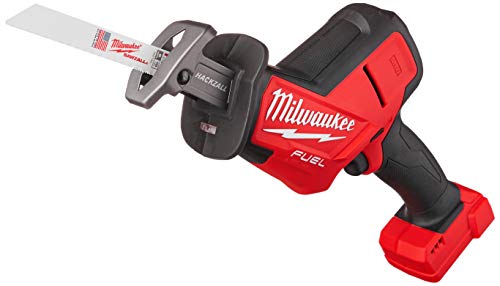
Top Cordless Reciprocating Saws for Demanding Cuts
The Milwaukee 2722-20 leads the pack with its POWERSTATE brushless motor and REDLINK PLUS intelligence, delivering exceptional cutting speed for demolition work. Its main advantage is unmatched performance in a compact package. The main limitation is its higher price and the need for a separate battery purchase if you don’t already own M18 batteries.
A 20V reciprocating saw is a staple for demolition, pruning, and plumbing work. Cordless models offer the freedom to cut anywhere without the hassle of cords. With so many options on the market, choosing the right one can be challenging.
We analyzed specifications and user feedback to bring you the top 20V reciprocating saws. Whether you need maximum power for heavy-duty use or a budget-friendly option for occasional tasks, this guide covers the best choices.
The best picks, ranked

Milwaukee M18 2722-20
The Milwaukee 2722-20 is a high-performance reciprocating saw designed for the toughest jobs. Its POWERSTATE brushless motor delivers unmatched speed and power, while the REDLINK PLUS intelligence optimizes performance and protects the tool. Users report excellent durability and cutting speed, making it a top choice for pros.
Pros
- Exceptional cutting speed
- Low vibration for better control
- Durable construction
Cons
- No battery or charger included
- Premium price

DeWalt 20V MAX DCS382B
The DeWalt DCS382B offers a 4-position blade clamp for flush cutting and a keyless lever for quick blade changes. Its brushless motor provides efficient power, and users appreciate the comfortable grip and low vibration. It is a reliable choice for both DIYers and professionals.
Pros
- 4-position blade clamp for flush cutting
- Keyless blade change
- Efficient brushless motor
Cons
- No battery included
- Slightly heavy

Makita XRJ05Z
Makita’s XRJ05Z is a top competitor with a powerful brushless motor that delivers 3,000 SPM. It features a crank mechanism for low vibration and a tool-less blade change system. Users find it well-balanced and easy to control, making it suitable for various applications.
Pros
- High stroke rate
- Low vibration crank mechanism
- Tool-less blade change
Cons
- No battery included
- Lacks a rafter hook

Bosch 20V CS5
The Bosch CS5 is designed with a patented blade change system and a low vibration handle. Its brushless motor provides consistent power, and users report that it feels comfortable even during extended use. It is a great option for those who prioritize ergonomics.
Pros
- Patented blade change system
- Low vibration
- Ergonomic handle
Cons
- No battery included
- A bit pricey

RIDGID 18V R8645B
The RIDGID R8645B offers a brushless motor and a variable speed trigger for controlled cutting. It comes with a wide range of features including a tool-less blade change and an adjustable shoe. Users appreciate its solid performance at a mid-range price point.
Pros
- Good price for brushless features
- Variable speed trigger
- Tool-less blade change
Cons
- Battery and charger not included
- Slightly heavier

Metabo HPT CR18DB
The Metabo HPT CR18DB is a compact reciprocating saw that is easy to handle in tight spaces. It features a brushless motor and a user-friendly design with a soft grip handle. Users find it lightweight and effective for many tasks, though not as powerful as larger models.
Pros
- Lightweight and compact
- Brushless motor
- Comfortable grip
Cons
- Less power for heavy-duty jobs
- No battery included

Craftsman V20 CMES5
The Craftsman V20 CMES5 is an affordable reciprocating saw that still offers a brushless motor and variable speed control. It comes with a tool-less blade change and a pivoting shoe. Users report that it handles most DIY tasks well, providing good value for the price.
Pros
- Affordable price point
- Brushless motor
- Variable speed trigger
Cons
- Build quality not as robust
- Battery and charger not included
The lineup, side by side
| # | Model | Motor | Best for | Score | Price |
|---|---|---|---|---|---|
| 1 | Milwaukee M18 2722-20 | Brushless POWERSTATE | Heavy demolition and professional use | 9.4 | Check price |
| 2 | DeWalt 20V MAX DCS382B | Brushless | Versatile use with adjustable shoe | 9.1 | Check price |
| 3 | Makita XRJ05Z | BL Brushless | Speed and balance | 9.0 | Check price |
| 4 | Bosch 20V CS5 | Brushless | Comfort and vibration control | 8.8 | Check price |
| 5 | RIDGID 18V R8645B | Brushless | Best value for the price | 8.7 | Check price |
| 6 | Metabo HPT CR18DB | Brushless | Compact and lightweight | 8.4 | Check price |
| 7 | Craftsman V20 CMES5 | Brushless | Budget-conscious DIYers | 8.1 | Check price |
How to pick the right one
Good to know
What is the difference between a reciprocating saw and a Sawzall?
Sawzall is a brand name that has become synonymous with reciprocating saws, similar to how Kleenex is used for tissues. The terms are often used interchangeably, but a reciprocating saw is the general product category.
Can I use a reciprocating saw for pruning trees?
Yes, with the appropriate wood-cutting blade, a reciprocating saw can handle branches and small trees. It is a popular tool for landscaping and tree trimming.
How do I choose the right blade for a reciprocating saw?
Choose a blade based on the material you are cutting. For wood, use a blade with fewer teeth per inch (TPI) for faster cuts. For metal, use a blade with more TPI and a finer tooth design. Always consider blade length and thickness.
Are 20V reciprocating saws powerful enough for demolition work?
Yes, modern 20V brushless models can deliver power comparable to corded saws. They are suitable for most demolition tasks, such as cutting through framing lumber, nails, and even light metal. However, for extreme continuous use, a corded saw might still be preferred.
What safety features should I look for in a reciprocating saw?
Key safety features include a lock-off switch to prevent accidental starts, a blade guard, and a shoe that stabilizes the saw. Wearing safety glasses and gloves is always recommended.
Can I cut metal with a reciprocating saw?
Yes, using a blade specifically designed for metal cutting. Blades with carbide teeth or bi-metal construction are effective for cutting through steel, aluminum, and other metals. Ensure you use a slower speed setting to avoid overheating the blade.
How do I reduce vibration when using a reciprocating saw?
Use a saw with anti-vibration technology, maintain a firm grip, and let the saw do the work without applying excessive pressure. Using a sharp blade also reduces vibration.
What is the ideal stroke length for a reciprocating saw?
The ideal stroke length is typically 1-1/8 inches or longer. Longer strokes cut faster because they remove more material per stroke. However, they may cause more vibration. Most quality saws have a stroke length between 1-1/8 and 1-1/4 inches.
The verdict
For professionals who need maximum power and speed, the Milwaukee 2722-20 is the clear winner. If you are on a budget but still want a reliable brushless saw, the Craftsman V20 offers the best value. For most users, we recommend the DeWalt DCS382B as a balanced choice that combines performance, durability, and adjustability at a reasonable price.
Jake Monroe
Jake worked as a residential contractor for over a decade before shifting to full-time writing. He evaluates power tools, hand tools and workshop gear through the lens of someone who has actually used them on job sites, not just read the box.